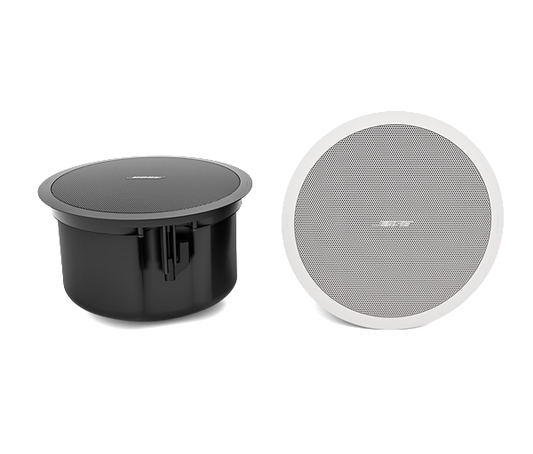
A commercial sound system plays background music and announcements evenly across a shop, restaurant, hotel or office, using ceiling, pendant or wall speakers, amplifiers and simple zone controls. The right design gives the same comfortable level in every corner, lets staff change the volume per area, and keeps running all day without attention.
This guide explains the parts of a commercial sound system, which speaker type suits which space, the difference between 70 V / 100 V and low impedance wiring, how to size amplifiers and zones, and what to check before you buy, for projects in Dubai, Abu Dhabi and across the UAE.
What a commercial sound system includes
- Sources: a music player or streaming service, a paging microphone, and sometimes a TV or event input.
- Mixer or audio processor: routes each source to each zone, sets levels and EQ, and lowers the music for announcements.
- Amplifiers: power the speakers, usually one amplifier channel per zone.
- Speakers: in the ceiling, hanging from it, on walls or outdoors.
- Controls: wall volume knobs or source selectors for staff in each zone.
See our commercial sound and PA solutions for how we design and install these systems.
Which speaker type suits which space
| Speaker type | Best for | Examples |
|---|---|---|
| In-ceiling speaker | Shops, offices, restaurants and corridors with a false ceiling | Bose FreeSpace FS4CE, FreeSpace FS2C, DesignMax DM3C |
| Edge-of-ceiling directional speaker | Premium retail, lobbies and restaurants where fewer speakers should cover the room from the perimeter | Bose EdgeMax EM90 and EM180 |
| Pendant speaker | Open or high ceilings, cafes, atriums and warehouses | Bose FreeSpace FS2P, JBL Control 64P/T |
| Surface or outdoor speaker | Terraces, pool decks, gyms and areas without a false ceiling | Bose ArenaMatch Utility AMU105 and AMU208 |
In-ceiling speakers
In-ceiling speakers are the standard choice because they spread sound evenly and stay out of sight. The Bose FreeSpace FS4CE has a 4.5 inch driver and a selectable 70/100 V transformer or 8 ohm bypass. The compact FreeSpace FS2C has a 2.25 inch driver, 16 W, 150 degree coverage and fits a 160 mm ceiling cut-out. The DesignMax DM3C covers 135 degrees with a published range of 75 Hz to 20,000 Hz for fuller music.


Edge-of-ceiling speakers
Bose EdgeMax speakers sit at the edge of the ceiling and direct sound into the room with PhaseGuide technology. The EdgeMax EM90 covers 90 degrees from a corner and the EdgeMax EM180 covers 180 degrees from a wall. In rooms where conventional ceiling speakers would need to be spread across the whole ceiling, EdgeMax can cover the space from the perimeter, which keeps the centre of the ceiling clear for lighting and design features.


Pendant speakers
When there is no false ceiling, pendant speakers hang on a cable to bring the sound down to the listeners. The Bose FreeSpace FS2P has a 2.25 inch driver, 16 W and 140 degree coverage from a single suspension point. The JBL Control 64P/T uses a 100 mm full-range driver and comes with hanging hardware for open architecture ceilings.


Outdoor and surface speakers
Terraces, pool decks and gyms need speakers rated for the conditions. The Bose ArenaMatch Utility AMU105 is a compact IP55 speaker with a 5.25 inch driver and 100 degree coverage. The larger AMU208 has two 8 inch woofers, a rotatable 90 x 60 degree horn, 400 W continuous power handling (AES) and IP55 protection. Both run on 70 V, 100 V or 8 ohm.


70 V / 100 V or low impedance?
| 70 V / 100 V line | Low impedance (4 or 8 ohm) | |
|---|---|---|
| How it works | Many speakers in parallel on one amplifier channel, each with a transformer tap | A few speakers per channel, no transformer |
| Cable runs | Long runs with thinner cable | Shorter runs, cable size matters more |
| Level per speaker | Set by choosing the tap | Same for every speaker on the channel |
| Best for | Shops, offices, malls, hotels, corridors | Bars, restaurants and venues where music quality comes first |
How many speakers and where
- Ceiling height: as a rough starting point, background music under a 2.7 to 3 m ceiling often uses one ceiling speaker every 3 to 5 m. Higher ceilings and wider coverage angles allow wider spacing.
- Music or speech: foreground music and clear announcements need closer spacing than quiet background music.
- Room shape: long, narrow spaces suit a single line of speakers; large open floors suit a grid.
- Perimeter coverage: EdgeMax speakers can cover a room from the walls and corners instead of a full ceiling grid.
- Construction stage: rough-in kits, such as the DesignMax DM3C rough-in kit, prepare each speaker opening before the ceiling is finished.
Choosing amplifiers
Choose an amplifier that supports the speaker line type and has enough channels for the zones. On a 70 V or 100 V channel, add up the tap power of every speaker and keep the total below the channel rating, leaving around 20 percent headroom.
- Bose PowerShareX PSX1204D and PSX4804D: four-channel power-sharing DSP amplifiers rated at 1200 W and 4800 W, at 4 to 8 ohm or 70/100 V. Power sharing lets busy zones use more of the total power than quiet ones.
- Biamp Voltera D 2400.4: a four-channel Class D amplifier with 2400 W total output, networked audio and onboard DSP.
- JBL CSA-2120: a compact two-channel amplifier with 2 x 120 W at 4/8 ohm for small shops and cafes.


Zones, volume control and paging
Each zone needs a simple control point for staff. The Bose ControlCenter CC-1D is a PoE wall controller with an illuminated rotary knob for supported Bose CSP, ESP and EX processors. On 70 V lines, the Biamp D-VOL60 is a 60 W wall-mounted volume control that adjusts the speakers in one area while the amplifier stays in the rack.


For announcements, a paging microphone or message player is routed to one zone or all zones, and the processor lowers the music automatically while someone speaks. Browse zone controllers and mixers.
Example systems by venue
| Venue | Speakers | Amplification and control |
|---|---|---|
| Boutique shop | 4 to 8 in-ceiling speakers such as FreeSpace FS4CE | Two-channel amplifier, one wall volume control |
| Restaurant or cafe | DesignMax or EdgeMax in the dining room, FS2P pendants over the counter | Multi-channel DSP amplifier, separate zones for dining, terrace and toilets |
| Office floor | FS2C or FS4CE on a 70/100 V line | One channel per area, paging microphone at reception |
| Hotel lobby and pool | EdgeMax in the lobby, ArenaMatch Utility outdoors | Power-sharing amplifier, zone controllers, scheduled levels |
| Gym or studio | ArenaMatch Utility or pendants, with subwoofers | Higher power channels for foreground music, a microphone input for classes |
Background music, paging and voice evacuation
Background music and paging systems are not fire evacuation systems. An emergency voice alarm system is part of the fire and life safety system and must be approved by the local civil defence authority. Some speakers, such as the Bose FreeSpace FS2C, FS2P and ArenaMatch Utility AMU208, are certified to EN 54-24 for voice alarm loudspeakers, but a certified speaker on its own does not make the whole system compliant. A music system can be wired to mute when the fire alarm activates.
Planning checklist before you buy
- Mark the zones on the floor plan and note the ceiling type and height in each.
- Decide background music, foreground music or speech for each zone.
- Choose 70/100 V or low impedance per zone, and keep one mode per amplifier channel.
- Add up the speaker taps per channel and leave headroom on the amplifier.
- Plan a wall control or volume knob for every zone staff will adjust.
- Plan rack space, ventilation and power for the amplifiers.
- Coordinate rough-in kits and ceiling openings with the ceiling contractor early.
Common mistakes to avoid
- Too few speakers turned up loud: it creates loud spots near each speaker and quiet gaps between them. More speakers at lower level sound better.
- Home speakers in a commercial space: they are not designed for all-day use, long cable runs or 70 V lines.
- One zone for the whole venue: the terrace, dining room and toilets need different levels.
- No volume control for staff: without a wall control, staff turn the amplifier itself up and down.
- Outdoor speakers without an IP rating: UAE heat, humidity and dust shorten the life of indoor speakers used outside.
Key terms explained
- Transformer tap: the power setting on a 70 V or 100 V speaker, such as 2, 4 or 8 W.
- Low impedance: speakers wired directly to the amplifier at 4 or 8 ohm.
- Zone: an area with its own source and volume.
- Ducking: lowering the music automatically during an announcement.
- IP55: protection against dust and water jets, used for outdoor speakers.
- EN 54-24: the European standard for voice alarm loudspeakers.
Get the right sound system for your venue
CorporateAV.ae designs, supplies and installs commercial sound systems across the UAE. We are an authorised dealer of Bose and Biamp, and a supplier of genuine JBL and d&b audiotechnik products. See our commercial sound and PA solutions, browse ceiling and wall speakers and amplifiers, or request a project quote.